
Precision chassis or stock: what are the concrete differences? How to guide your choice
When preparing a rifle, the question quickly arises: should you go for a chassis or a more classic stock?
The two do not have the same logic.

-A chassis is primarily designed for rigidity, modularity and adjustability.
-A classic stock generally prioritizes simplicity, a natural grip and, depending on the model, a more understated or lighter overall design.
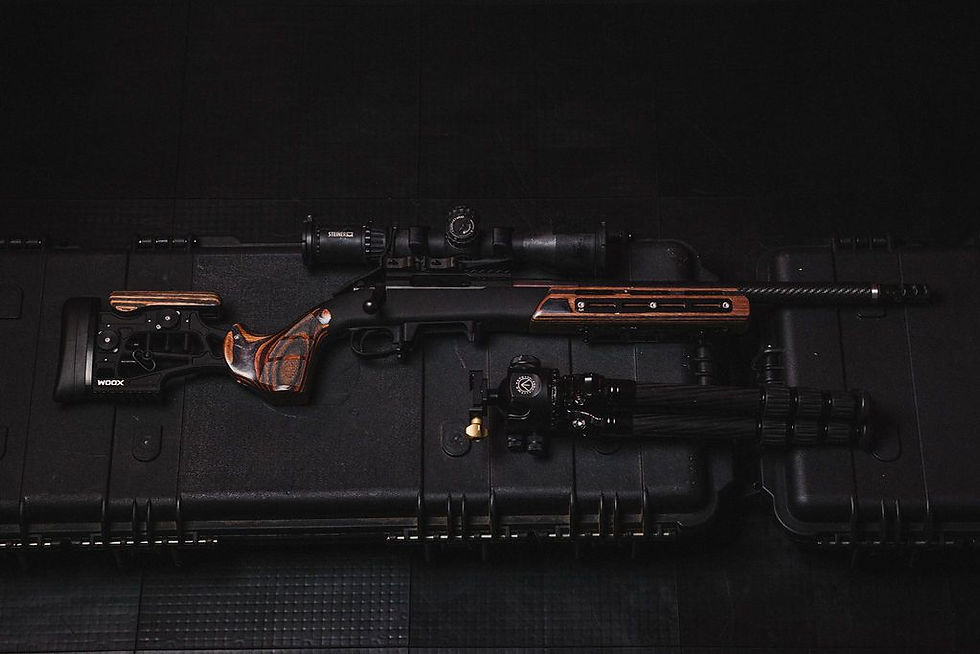
The line is also less clear than before, because today there are hybrid solutions that retain a traditional shape while integrating an aluminum core (WOOX) or a mini-chassis.
What is a chassis?

Woox furiosa ultra
A precision chassis is a rigid structure, most often made of aluminum , designed to receive the action in a very stable and repeatable way. Modern models feature adjustable stock length and cheek rest, compatibility with AICS standard magazines, and accessory interfaces such as M-LOK, ARCA, or Picatinny.
The chassis is designed as a technical platform: it facilitates the adaptation of the weapon to the shooter and the intended use.
What is a classic stock?

A classic stock adopts a more traditional silhouette.
It can be made of wood, composite, polymer, or in some cases combine several materials. Its main advantages are often intuitive ergonomics , lightness, simplicity, and a more "natural" feel on the shoulder or in the hand.
A good modern stock can already offer a very solid foundation for precision shooting at moderate/medium distances.
Rigidity is often where the chassis has the advantage.
A metal structure or one with a rigid internal metal skeleton moves little, maintains the overall geometry better and better withstands the stresses related to the bipod, front supports or accessories.


Conversely, some injected polymer stocks can be flexible enough to affect barrel behavior when heavily loaded on a rest. This is one of the reasons why many shooters switch to a stiffer stock when seeking greater consistency.


The most noticeable difference: the settings
A chassis generally offers more possibilities for adjusting the weapon to the shooter: stock length, cheek rest height, more vertical grip, rail mounting, accessory compatibility, evolution of the configuration over time.


This is a real advantage when you want to optimize your position behind the scope, repeat the same aiming technique, or adapt the setup for multiple uses. A traditional stock can be very effective, but it's often less open in this respect, except on high-end or hybrid models.
Weight and carrying
For a long time, the classic criticism leveled at the chassis was simple: too heavy, too bulky, too much of a “shooting platform” for mobile use.
There are now chassis designed for hunting or for light, simple configurations, which retain the advantages of chassis but are oriented towards hunting.


However, if the primary objective is to carry for a long time and the shooting distances are not too far, keeping a classic stock often retains a practical advantage.
The feeling on the ground

A classic stock often gives a more familiar, smoother, sometimes more pleasant feel, especially in wood or composite.
A pure chassis can seem more technical, more angular, sometimes colder in certain conditions. This is precisely why several manufacturers have developed hybrid solutions: a rigid chassis core, but a shape or surfaces designed to provide a more traditional feel.
Key points to remember in practice
- If the main objective is precision shooting , shooting from a fixed position, long-range shooting, or working with a bipod, backpack, tripod, or accessories, a chassis often has the advantage. It provides a rigid base, more advanced adjustments, and a better platform logic.
- If the goal is a simpler , more understated weapon, comfortable to carry, more traditional in its handling, a good classic stock remains an excellent choice.
- And if we want a compromise , hybrid or mini-chassis solutions are probably the most suitable today: they retain a familiar shape while taking on some of the advantages of a modern chassis.
The real issue is not whether a chassis is “better” than a stock in absolute terms.
The real question is what we expect from the whole thing.
The chassis promotes rigidity, adjustability, and modularity. The classic stock often favors simplicity, portability, and a more natural feel.
A good modern stock can be very effective. Conversely, a stock that is too flexible can become a real limitation as soon as consistency is sought.
The right choice therefore depends less on style than on actual use.


Comments